An account of how the Cypriots gained victory over Alexandria | ذكر كيفية ظفر القبرسي بالإسكندرية
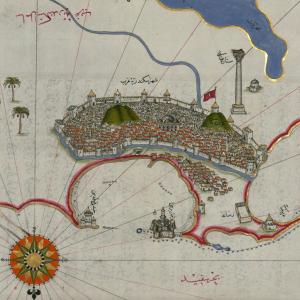
Reis, Piri. “City of Alexandria” (illumination) Kitāb-i baḥriye. Baltimore, Walters Art Museum, MS W658. fol. 302a. [Licensed for use under Creative Commons Attribution-NonCommercial-ShareAlike 3.0 Unported Access Rights]
Al-Nuwayri al-Iskandarani wrote in the general context of the political instability of the Bahri Mamluk period, and he explored many topics of interest to the social and cultural historian of the medieval Mediterranean. The narrative of the sack of the city cites numerous eyewitness accounts from a cast of residents of Alexandria, as it constructs a critique of the tactical choices made to protect the city against the siege. The text has much to offer literary historians, since the author was a copyist of Arabic manuscripts for the rich merchants of Alexandria and his extensive knowledge from manuscript collections makes its way into his account of the sack of Alexandria: anecdotes and citations of Arabic poetry--including an excerpt from Ibn Zaydun's famous “Nūniyya” poem at the very end--as well as poetry composed for the occasion in a variety of genres: praise, elegy and satire. The events of the raid on Alexandria are repeatedly linked to the history of early Islam and al-Andalus (for example, the battle of Uhud and the fall of Lorca), but also to fascinating interpolations on the stratagems of war from the legendary correspondence of Alexander the Great and Aristotle, including using birds as incendiary weapons and building armies of automata. In this partial translation, al-Nuwayri al-Iskandarani touches on the origin of the peoples of Alexandria, he provides vivid examples of martyrdom in the face of violence and punctuates his account with a providential explanation for the fall of the city. Particularly striking are the vivid descriptions of the material and architectural richness of the city of Alexandria, its mosques, markets and fortifications in the fourteenth century. Maps of the medieval Arab city are rare, let alone with locations marked on them, but fol. 302a of Walters ms 658 of Piri Reis's Kitāb-i baḥriye gives some idea of the layout of the city from the post-raid perspective the 1550s.
Since Atiya, the Kitab al-Ilmam has been known as the most significant eyewitness account in Arabic of the sack of Alexandria, and yet materials in translation from the other languages of the period of the “late crusades,” such as Turkish and Arabic are generally missing. The sack of Alexandria is but one of a number of raids led by King Peter I of Cyprus on coastal cities of the eastern Mediterranean: Korikos (1360), Antalya (1363), Alexandria (1365), Tripoli (1367), Latakia (1368). Where as Western European treatment of King Peter, as we find in Guillaume de Machaut's Prise d’Alixandre and Geoffrey Chaucer’s Knight’s Tale and Monk’s Tale) gloss over the violence and material greed of such raids, this translated excerpt provides readers with the unique vantage point of a Muslim perspective on the sack of Alexandria, as well as a glimpse of both intercultural contact and material culture of the period.
About this Edition
This translation is based on the critical edition by Atiya (Hyderabad, 1968-76). The translation is divided into meaningful sentences for the English reader. The Arabic text preserves the original punctuation of the edited text. # marks in both the Arabic and English texts indicate breaks in the original text.
I have made an attempt to preserve rhyme in the poetic fragments to give a flavor of the style, although this has not always been possible. Arabic prose can have an enumerative, rhythmic quality, listing many objects in sequence, such as the first paragraph translated in this excerpt that lists the equipment of the military regiment. We have followed Atiya's translations for the names of locations in medieval Alexandria where available. This translation is replete with descriptions of objects and places, the names of which can be difficult to translate. An effort has been made to find equivalents where possible.
Concerning the translation's structure, I have preserved the digressive quality of the writing that sets the narrative of the raid within a fabric of other of the author's concerns. The reader will notice that al-Nuwayri al-Iskandarani switches between the events of the Alexandrian raid and other moments in Islamic history and that these digressive segments are marked by the phrase “End of quotation.”
Our thanks go to Alexander Key and Sarra Ghodbane for their careful reading and many wonderful suggestions for the revision of the translation.
Further Reading
Atiya, Aziz Souryal. The Crusade in the Later Middle Ages. Meuthen, 1938.
- A general monograph on the phenomenon of crusading in the 14th and 15th century, written by the editor.
Atiya, Aziz Souryal. A Fourteenth-Century Encyclopedist from Alexandria: A Critical and Analytical Study of al-Nuwayri al-Iskandarāni‟s “Kitāb al-Ilmām.” U of Utah Middle East Center, 1977.
- A critical essay contextualizing the work by Al-Nuwayri al-Iskandarani within his time, written by the editor of the Kitab al-Ilmam.
Reis, Piri. “City of Alexandria” (illumination) Kitāb-i baḥriye. Walters ms. W658. fol. 302a. https://www.thedigitalwalters.org/Data/WaltersManuscripts/html/W658/description.html
- An illumination of the city of Alexandria, its ports and walls from the 1550s, as seen by the Ottomans.
Sells, Michael, trans. “To al-Andalus Would She Return the Greeting: Ibn Zaydun's Nuniyya (Poem in N), Complete Translation.” The Literature of Al-Andalus, edited by Maria Rosa Menocal, Raymond P. Scheindlin, and Michael Sells. Cambridge UP, 2000, pp. 489-96.
- A translation of Ibn Zaydun's Nuniyya poem, an excerpt of which is included at the very end of the translation.
van Steenbergen, Jo. “The Alexandrian Crusade (1365) and the Mamlūk Sources: Reassessment of the Kitāb al-Ilmām of an-Nuwairī al-Iskandarānī (D. A.D. 1372).” East and West in the Crusader States: Context – Contacts – Confrontations vol. 3, edited by K. Ciggar and H.G.B. Teule. Peeters, 2003, pp. 123-37.
- A comparison of Al-Nuwayri al-Iskandarani's chronicle to other Mamluk historical sources of the event.
Wrisley, David Joseph. “Historical Narration and Digression in al-Nuwairī al-Iskandarānī's Kitāb al-Ilmām.” Philippe de Mézières and His Age: Piety and Politics in the Fourteenth Century, The Medieval Mediterranean: Peoples, Economies & Cultures 91. Edited by Renate Blumenfeld-Kosinski and Kiril Petkov. Brill, 2012, pp. 451-74.
- An analysis of Al-Nuwayri al-Iskandarani's use of historical digression and his framing of contemporary events within Islamic history.
“An account of how the Cypriots gained victory over Alexandria”
The prince Ṣalāḥ al-Dīn ibn ʿArām, the vice-sultan was absent from the inlet of Alexandria, since he was in Holy Hijaz to complete his hajj. Meanwhile, the Atabeg prince Yalbughā al-Khāssikiyy, also known as “Janghara,” was acting in his place. When Janghara came to Alexandria, he saw the reserve guard regiments in the port advancing onto the peninsula. They brandished well-strung bows and displayed silk banners, carrying javelins, lances, shields, halberds, layered coats of mail and armor and blazing Greek fire. They wore so many colors that they looked like flowers in a garden. When he spotted them, tears fell from his eyes and he said: “These are the people of paradise. Look at their devotion and how they strive in the cause of Allah. How delightful our life has become, oh Allah, thanks to the strength of this army. If all the Christians would come to Alexandria, not only could they not fend off this mighty army, but they would be broken, left dead or hostaged.”
Janghara was in Alexandria for three months from Shawwal in the year 766 until Muharram. He saw the regiments that took turns each day of the week watching over the coastal port. He even slept nights in a small room near the Turbat Ṭāghiyya mosque in front of which he had placed two lanterns completely full of oil. The regiment known as the “Blue Regiment” came and was launching burning oil. Janghara caught a glimpse through the arrow hole in the room’s wall of the flying sparks and the spinning flamethrowers combusting in all colors, from green to yellow, white to red. He feasted his eyes on this display from dusk to dawn. It brought him joy also to see so many people spread out on the coastal front line, military and civilians alike. A market was set up for them with all kinds of food to buy and eat, and waterskins were brought from inland so they could drink. In the morning, the large regiment that had guarded the city entrance all night got back into formation with zeal and vigor, and in great numbers. The city’s men and women gathered together for the occasion, and they saw the regiments, their beautiful clothes and their white robes looked like flowers in a garden. Upon seeing them, the ladies announcing their arrival by ululating and the horns blew, the symbols clashed and the mizāmir bellowed. Flags waved and censers were lit and an aromatic smoke wafted through the air. Each and every soul took pleasure in these beautiful smells. And the people were delighted to see the victorious army, the houses and streets shaking with the regiments’ advance. As was their custom—self-assured on their inlet—
ريمألا وهو ،ةيردنكسإلا رغثب ناطلسلا بئان نأ كلذ و روكذملا رغثلا نع ابئاغ ناك مارع نب نيدلا حالص ليلخ ةراشإب هيف هنع ابئان ناكو جحلا ببسب فيرشلا زاجحلاب املف .ارغنج ىمسي ريمأ ىكساخلا اغبلي ىكبتالا ريمألا ةعوطتملا اهفئاوط ىأر ةيردنكسإلا روكذملا ارغنج لخد خرجلا مهيّسقب ةريزجلاب هيلع رجنت اهءانيمل ةسراحلا نم مهيديأب ام عم ، ةروشنملا ريرحلا مهمالعأ و ةرتوملا ديضنلا درزلا و حافصلا و قردلا و ، حامرلا و قيرازملا هنم دعاصلا ،رايطلا طفنلا و ، ديدحلا تاحفصم و ، رهزلاك ، ناولألا فلتخملا مهسوبلمب مه و ،رانلا بهل لهأ ءالؤه # :لاق و ىكب ارغنج مهنياع املف .ناتسبلا يف هللا و باط دق # هللا ليبس يف مهداهج و مهطابرل ةنجلا عيمج ةيردنكسإلا ىلإ ىتا ول # شيجلا اذه ةوقب شيعلا ىلع ليقثلا شيجلا اذه ىلع اوردق ام ،ةينامورلا ىراصن ىلتق مهنوريصي و ،ىراصنلا نورسكي لب ، ةيردنكسإلا ىراسأ
نيتس و تس ةنس لاوش نم ةيردنكسإلاب ارغنج ماقأف لكل يتلا فئاوطلا كلتل رظني مرحملا ىلإ ةئامعبس و لحاسب سرحت تيبت عوبسألا يف ةليل اهنم ةفئاط دجسم باب ىلع يتلا ةفرغلا يف يلايل تاب امبر و ،ءانيملا باب لباقم نيتركأ نيسوناق همادق مدقي و ،ةيغط ةبرت و طفنلا نوقلطي نيقارزلا ةفئاط يتأت و .روكذملا دجسملا و ،رايطلا رارشلا ىلإ ةروكذملا ةفرغلا ناقيط نم رظني وه و ،ةرفصلا و ةرضخلا نم ،رانلا ناولأب رودت يتلا بلاوللا ىلإ ىشعلا نم ،حارشنإلا كلذب لصحيف .ةرمحلا و ضايبلا ةرشتنملا قئالخلا ةرثك ىلإ هرظنب اضيأ جهتبي و ،حابصلا قوس مهل بصن دق و ،ماوعلا و ةامرلا نم لحاسلا ىلع ءام نم و # ،نولكأي و نورتشي لوكأملا فانصأ نم هيف اذإف .نوبرشي مهيلإ دلبلا نم لمحت يتلا برقلا و اياورلا دلبلا لخدم سرحت تتاب يتلا ةفئاطلا تمظتنإ اوحبصأ و لاجرلا مهلوخدل عمتجتف ،ددم و ةرثكو ،دلج و ةمه يف سبالملا نسح نم ،ناتسب رهزكماوقأل نورظني ،ناوسنلا ،انالعإ ناوسنلا مهل نترغزتف ،سلابطلا كلت ضايب و و ،خرصت ذئنيح قاوبألا و ،انايع مهل نهتدهاشم دنع و ،ةروشنم مالعألا و ،رمزت رمازملا و ،قدت تاسوكلا كلتل طسبنتف ،حوفي اهناخد و ،ةرومعم بيطلاب رخابملا ةيؤرل ،رورس و حرف يف سانلاو ،حور لك ةجرألا حئاورلا امنيف .رودلا و عراوشلا هل زتهملا روبحملا شيجلا كلذ ،نونئمطم مهرغث يف و ،نورمتسم مهتداع ىلع كلذكمه مهمهد ذإ ،ادبأ اهوركم اوار ال و ءادعألا مهعورت ال و مهلمش تتش ،نيلاضلا هدنج يف ،نيعللا سربق بحاص نادلبلا يف هنم اورف ،نيعمجأ،
their faces did not betray the slightest fear of the enemy, nor did they see the deception or the coming attack of the cursed Cypriots and their infidel soldiers—may Allah scatter them about and make them run back to their countries. And the regiments entered the city with ease. This was on Friday, 22 Muharram 767, when the Nile River spilled over its banks. The cursed [Cypriots] planned to come at that very moment to forestall reinforcements arriving from Cairo on account of the long distance across the terrain. That day the sly Cypriots managed to do just that, securing their position before help came by boat. The Cypriots were happy on account of their own safety and their gain. If there had been powerful princes nearby the sly Cypriots would not have gained a penny, # but alas it was meant to be, and by Allah’s will, it was fated to happen.
Yazīd ibn Ḥabīb said that when ʿAmr ibn al-ʿĀṣ—may Allah be pleased with him—first conquered Alexandria # he found its home and its buildings empty and he thought that he should live there. He said: “these dwellings will suffice for us” # and he wrote to ʿUmar ibn al-Khaṭṭāb—may Allah be pleased with him—asking him to accept that they live there. Umar inquired of his messenger : “Is there water between me and the Muslims?” The latter responded: “Yes, Prince of the Faithful, provided the Nile flows.” So, ‘Umar wrote to ‘Amr: “I do not like that the Muslims are settled in a place separated from us by water—in winter as in summer—except if they are outnumbered.” So, ʿAmr ibn al-ʿĀṣ left Alexandria for Cairo.
ʿUmar ibn al-Khaṭṭāb —may Allah be pleased with him— had said that out of precaution, since so few Muslims lived in Alexandria and the course of the Nile through the hills would make it dangerous if ever he needed to send help. ‘Amr ibn al-ʿĀṣ sent them people from the Arabian tribes: Lakhm, Judhām, Kinda, al-Azd, Ḥaḍramawt, Khuzāʿa, and al-Muzayna and he settled them in two groups for protection. The Lakhm lived in a place known as Kūm al-Dikka, the Judhām in Birkat Judhām, the Kinda in Barākil, and al-Azd in Ḥārat al-Azdiyy. Ḥaḍramawt settled in Ḥārat al-Ḥaḍārima, and Khuzāʿa settled with al-Muzayna in the direction of Abūqīr in the eastern outskirts of Alexandria where they guarded its port. Those from the abovementioned tribes who lived in the center of Alexandria watched over two ports, one to the east and one to the west of the peninsula. The descendants of those tribes are today in the year 775 still known as the “tribes” in Alexandria. They have thirty-three leaders who act as the guardians of their ancestral traditions. They still dress in Arab garb. The cloth on their turban hangs low and
و يناثلا ةعمجلا موي يف كلذ و ،نانئمطاب دلبلا لخد و و ،ةئامعبس و نيتس و عبس ةنس مرحملا نم نيرشعلا نمزلا كلذ هنايتاب نوعلملا دصق ،دالبلا ىلع رشتنم لينلا لانف ،لبجلا نم قيرطلا دعبل رصم نم ةدجنلا قوعتتل لبق نصحت و ،هدعب يذلا و مويلا كلذ يف هدصق ثيبخلا ،هبساكم و هسفن ةمالسب حرف و ،هبكارمب ةدجنلا نايتإ ،ةدرز نمث اهنم ثيبخلا لان ام ةدرجم ءارمأ اهب ناك ولف ةدرز نمث اهنم ثيبخلا لان ام ةدرجم ءارمأ اهب ناك ولف اردق هللا رمأ ناك و ،اروطسم باتكلا يف كلذ ناك نكل # ارودقم.
هنع هللا يضر صاعلا نب ورمع نأ بيبح نب ديزي نع اهنم اغورفم اهءانب و اهتويب ىأر و # ،ةيردنكسإلا حتف امل ىلإ بتكف #،اهانيفك دق نكاسم :لاق و اهنكسي نأ مّه لاقف ،كلذ يف هنذأتسي هنع هللا يضر باطخلا نب رمع :لاق ؟ءام نيملسملا نيب و ينيب لوحي له :هلوسرل رمع ىلإ رمع بتكف ،لينلا ىرج اذإ ،نينمؤملا ريمأ اي معن ءاملا لوحي الزنم نيملسملا لزنت نأ بحأ ال ينإ :ورمع لوحتف ،اورثك اذإ الإ فيص ال و ءاتش يف مهنيب و ينيب رصم ىلإ ةيردنكسإلا نم صاعلا نب ورمع،
ىلع افوخ هنع هللا يضر باطخلا نب رمع كلذ لعف لينلا نابإ يف ،اهيلإ ةفاسملا دعب و ،اهب مهتلقل نيملسملا نب ورمع اهيلإ لسرأف .ةدجنلل لبجلا يف قيرطلا ةرودل و ةدنك و ماذج و مخل نم برعلا لئابق ذئنيح صاعلا نينطاق نيزكرم ةسئازملا و ةعازخ و تومرضح و دزألا موكب فورعملا ناكملاب تلزن مخلف ،اهتسارحل اهب ،لكاربلاب تلزن ةدنكو ،ماذج ةكربب تلزن ماذج و ،ةكدلا ةراحب تلزن تومرضح و ،ىدزألا ةراحب تلزن دزألا و ىقرش ريقوب ةيحانب اولزن ةنيازملا و ةعازخ و ةمراضحلا اولزن نيذلا و ،اهءانيم نوسرحي ،اهرهاظ نم ةيردنكسإلا كاردإ مهيلع نيروكذملا لئابقلا نم ةيردنكسالا نطاب و .”ةيردنكسإلا ةريزجب“ ةيبرغلا و ةيقرشلا نيءانيملا و نيعبس و سمخ ةنس يف نآلا ىلإ لئابقلا ءالؤه ةيرذ ،رابخأ مهل ،لئابقلاب ةيردنكسإلا يف نورفسي ةئامعبس مدقم لك دي تحت ،امدقم نوثالث و ةئام ثالث مه و ،برعلا سوبل قيرط نع اوجرخي مل لئابقلا نم ةعامج ىراج ىلع ،مهعئارد نوجرفي و تابذعلا نولدسي لب مهفالسأ نم نابرعلا ةداع،
they brandish their shields just like their Arabian ancestors did. ʿAmr ibn al-ʿĀṣ divided up his men, a quarter of them to protect Alexandria, another quarter for the coastline, while the remaining half of them stayed with him in Cairo. In Alexandria half of them would stay for six months, and then next rotation would come for the rest of the year. End of quotation.
Let us return to the account of how the Cypriots came to Alexandria and captured it. On Wednesday, 20 Muharram in the year 767, boats appeared at sea to the east and the west. The Alexandrians thought that they were the Venetian merchants whose goods were long awaited each year. The Muslims traders used to bring all kinds of spices from Yemen [to Alexandria] and sell or barter them with the Venetians. When the boats did not enter the port, the people of Alexandria were very scared. On Thursday, many more boats arrived and prepared to touch down on the peninsula, looming on the horizon like turrets of white castles. The people in Alexandria all lined up and were fervently and nervously asking each other about the scene. The boats approached, filling the sea from all directions, and parting it like an earthquake splits the land. Finally, the strongholds stopped in the sea in formation on the side of the Green Gate
—this is the very gate that after the raid had been sealed up with lime and stone. Since then, it has been made functional again with the opening of three new gates. The events of the Cypriot raid took place in 767 in the wilāyya of Prince Sayf al-Dīn al-Akaz and in the city of Alexandria. Insha’Allah, an account of his wilāyya, and what happened in it, will be presented below.
Let us return to the account: when the war boats anchored at sea, visible from the shore, the people of Alexandria prepared themselves for war. The fortresses filled up from both the sides—the sea and of the peninsula—with many men ready to hurl weapons. The people spread out along the fortress walls and they filled up with javelin throwers. The Franks left their boats in small dinghies to reconnoiter the port by moonlight. The Muslims shot arrows at them # and they hurried back to their boats.
At sunset they lit their lanterns on the walls, filling the space with light. The Muslims appeared ready and were gazing over the walls. The infernal enemy did not move from the spot at which they anchored and their boats were all grouped together so they looked like a single small raft floating in a big sea. The Muslims underestimatedthe danger, saying:
:ةيردنكسإلا طابرل هباحصأ نم صاعلا نب ورمع عطق و هعم نوميقم فصنلا و ،لحاوسلا يف عبر و ،سانلا عبر فيصلا يف عبرلا ةصاخ ةيردنكسإلاب ريصي ناك و ،رصمب ىهتنا رهشأ ةتس ةيناش مهدعب بقعت و ،رهشأ ةتس ردقب.
و ةيردنكسإلا ىلإ ىسربقلا نايتإ ةيفيك ركذ ىلإ دوعن نيرشعلا ءاعبرألا موي يف ناك امل هنأ كلذ و ،اهب هرفظ رحبلا يف رهظ ةئامعبس و نيتس و عبس ةنس مرحملا نم مهنأ ةيردنكسإلا لهأ معز ،ةقرشم و ةبرّغم بكارم ىراج ىلع مهرجاتمب نوتأي مهنورظتني ةقدانبلا راجت مهل اوبلج نيملسملا راجت تناك و ،ةنس لك يف مهتداع نوضوعتي و ،مهيلع اهنوعيبي راهبلا فانصأ نميلا نم سانلا تتاب ءانيملا اولخدي مل املف ،مهرجاتم نم اهنع تلبقأ سيمخلا موي حبصأ املف ،مهببسب ديدش فوخ يف اهعالق ةروشنم ،ةريزجلا لحاس ةبلاط ،ةريثكلا بكارملا نم ،ضيرعلا ليوطلا يف سانلا راصف ،ضيبلا روصقلاك ةعلقم بكارملا كلت و ،مهجه و رّح و ،مهجهل ةرثك رحبلا قشت لزت ملف ،ةيحان لكنم رحبلا تألم دق ،ةيتآ كلذ و ،ةلسلسلا رحبب اهعالق تطّح نأ ىلإ ،ةلزلزلاك و ريجلاب ةعقولا دعب دودسملا رضخألا بابلا ةهج نم و لوألا هباوبأ هيلع تبكّرُ و ،كلذ دعب حتف مث ،رجحلا ةنس ةعقولا موي يف كلذ و ،ةددجتملا ثلاثلا و يناثلا زكألا نيدلا فيس ريمألا ةيالو يف ةئامعبس و نيتس و عبس نإ اهيف لعف ام و اهب هتيالو ركذ يتأيس و ،ةيردنكسإلاب ىلاعت هللا ءاش.
ةزربم ةلسلسلا رحبب ةيبرحلا بكارملا تسرأ امل و ،دوعن برحلا و ،لاتقلل ةيردنكسإلا لهأ تدتعا لحاسلا نع ،ةريزجلا و رحبلا ةهج نم يتلا عالقلا ترمعتف ،لازنلا و ةامرب راص و ،روسلا ىلع سانلا ترشتنا و ،ةريثكلا ةامرلاب سبحي براق جنرفلا بكارم نم جرخف .ارومعم خرجلا ىلوف #.ماهسلاب هيلع نوملسملا ىمرف ،ةريمقب ءانيملا بكارملاب قصل ىتح ابراه.
،روسلا ىلع سيناوفلا تدقوُ بورغلا دعب ناك املف روسلاب و ،نيبهأتم نوملسملا ناب و ،رونلاب روسلا ءاضف يذلا عضوملا نم كرحتي مل سناخ ودعلا و ،نيقدحم ضعب ىلإ اهضعب ةمضّنم بكارملا كلت تراص و ،هب ىسرأ نوملسملا نوهتساف ،ريبكلا رحبلا يف ،ريغصلا فوطلاك اولاق و هرمأ:
“They can do nothing to this city. It is walled and fortified, and the fortresses are strong and enduring.” When the sun rose on Friday morning, many Muslims had already deployed onto the coast of the peninsula. Some of them were carrying swords and shields, others bows and arrows, or javelins and daggers, or even some wearing only ordinary clothing. Some of them were wearing a coat of mail, others were simply unarmed. Food sellers came out of the city carrying trays, pots and containers full of things to eat. Throughout Thursday night they sold their food to everyone, in order to make their living. As they worked they cursed the monks and priests, but without the slightest fear of the boats that appeared Wednesday at sea, nor were they alarmed by the Franks collective advances on Thursday. They were cursing the Cypriots as if they were Iblīs, as they complacently served their food to the many regiments mentioned above. One of them would get furious if the men took one or two bites too many; on the other hand, if the seller cheated his buyer out of one or two bites he was thrilled. As the old poem about the seller goes:
Don’t anger the vendor, every penny makes him gay. As if pulling his molar from ‘em, yank that coin away.
They bought and ate from the foodsellers, when they would come out with the army regiments. They were not much thinking of the Frankish fleet, nor were they particularly scared. The rabble and the riffraff were openly cursing the Cypriots, with all kinds of expletives. The Cypriots could hear them from their boats, but they stayed silent. None of their men uttered a word. They just stayed silent. It was said: “From the tip of the peninsula at night, the Cypriot king sent his spies dressed in Muslim garb, speaking strange Arabic. They encircled the Muslims, spying on them.” Then the Cypriots noticed that they were not donning war garb. The Cypriots bought some food and brought it back to the leader of the fleet. They told him: “There are no intrepid men on the peninsula, and no one is dressed in war garb. Instead, they are eating and drinking, and some of them are even sleeping in the sand.”
Before sunrise on Friday morning, the Arabs arrived from all directions. The infiltrated the city wearing their usual garb. The women were watching the Frankish boats from the observation towers in the walls overlooking the cemetery. They ululated when they saw the Arabs and said, “The heroes have just arrived and they are going to kill the cross worshippers.” They were running their horses around below the observation towers. When they heard the utulation, they
و ،ةنيصحلا ةروسملا ،ةنيدملا هذه ىلع اذه ردقي ام سمشلا عولط دعب ناك املف> ،ةنيتملا ةديشملا عالقلا نم قلخ ةريزجلاب لحاسلا ىلع رشتنا ةعمجلا موي نم مهنم و ،هسرت و هفيس هعم نم مهنم ،ةريثك نيملسملا و ،هرجنخ و هحمر هعم نم مهنم و ،هسوق و هلين هعم نم دق مهضعب و ،هرتسي يذلا هبوث ىوس هيلع سيل نم مهنم تناكو ،درجم راع وه نم مهضعب و ،دضنملا درزلا سبل مهتوسد و مهرودق و مهبلاطب دلبلا نم اوجرخ ةعابلا و صاخلا نم ةريزجلاب نم ىلع اهنوعيبي ،ماعطلاب ةنآلم و مهشياعم يف اوبسكيل سيمخلا ةليل نم كلذ و ،ماعلا ريغ نم كلذ و ،سيسق و بهار لك نعلب نونلعم مه ،رحبلا يف ءاعبرألا موي تيثر يتلا بكارملا نم فوخ موي مهتطورفأ عامتجاب جنرفإلا نم اوعزف ام مهنإ مث ،سيلبإلا مهنعلك ىسربقلا نونعلي اوراص لب ،سيمخلا مدقتملا فئاوطلا ىلع مهعيب نم مهل مدقت اميف مهنمأل ةبح ىرتشملا هل صقن اذإ بضغي مهدحأ ناكف ،مهركذ ريصيف ،ةدحاو ةبحب يرتشملا بلغ اذإ حرفي و ،نيتبح وأ رعاشلا لاق امك عئابلا:
هيضرت ةبحلايف ىقوسلا بضغت ال
هيف نم سرضلا ذخآكهيدي نم سلفلا ذخا و
يف اوناك امك ،نولكأي و ةعابلا نم نورتشي اوراصف ركفم مهنم لك سيل و ،نودهعي فئاوطلا عم مهجورخ شيفارحلا تراص و ،فئاخ هنم ال و جنرفلا لوطسأ يف ظفل لكب هنوبسي و ،حيرصلاب ىسربقلا نومتشي ماوعلا و لكو ،تكاس وه و هبكارم نم مهعمسي ىسربقلا و ،حيبق نإ :ليقف ،تماص مهنم لك لب ةملكب قطني مل هعم نم يف هسيساوج ليللا يف ةريزجلا ىدعأ نم ىمر ىسربقلا اوطاتحاف #،نيطايشلاك نيبرعتسم ،نيملسملا سابل يّز ،نييراع برحلا سابل نم مهوأرف ،نيسسجتم نيملسملاب سربق بحاصل هب اوتأ و لوكأملا نم ليق امكنم اورتشاف ،ناعجشلا نم دحأ ةريزجلاب سيل :هل اولاق و ،لوطسألاب و نولكأي ،نايرع برحلا سابل نم وه نم الإ اهب سيل و نوماني اهب و رئافح لمرلا يف رفحي مهضعب و ،نوبرشي.
ةعمجلا موي نم سمشلا عولط لبق اهب ناك املف اوللخت دق ،ناكم و ةيحان لك نم ،نابرعلا تلبقأ جنرفلا بكارم ىلإ نرظني ناوسنلا تناك و ،نايسكلاب ىلع ةفرشملا ،روسلا لخاد يه يتلا ،ناميكلا سؤر نم تتأ دق :نلق و .نابرعلا كلتل ناوسنلا تتغرزف ،روبقلا نودراطتي اوراصف ،نابلصلا دابع نولتقي ،ناعجشلا دنع ةتعألا اهل اوخرأ دق و ،ناميكلا تحت مهلويخ ىلع ةترغزلا مهعامس
4